
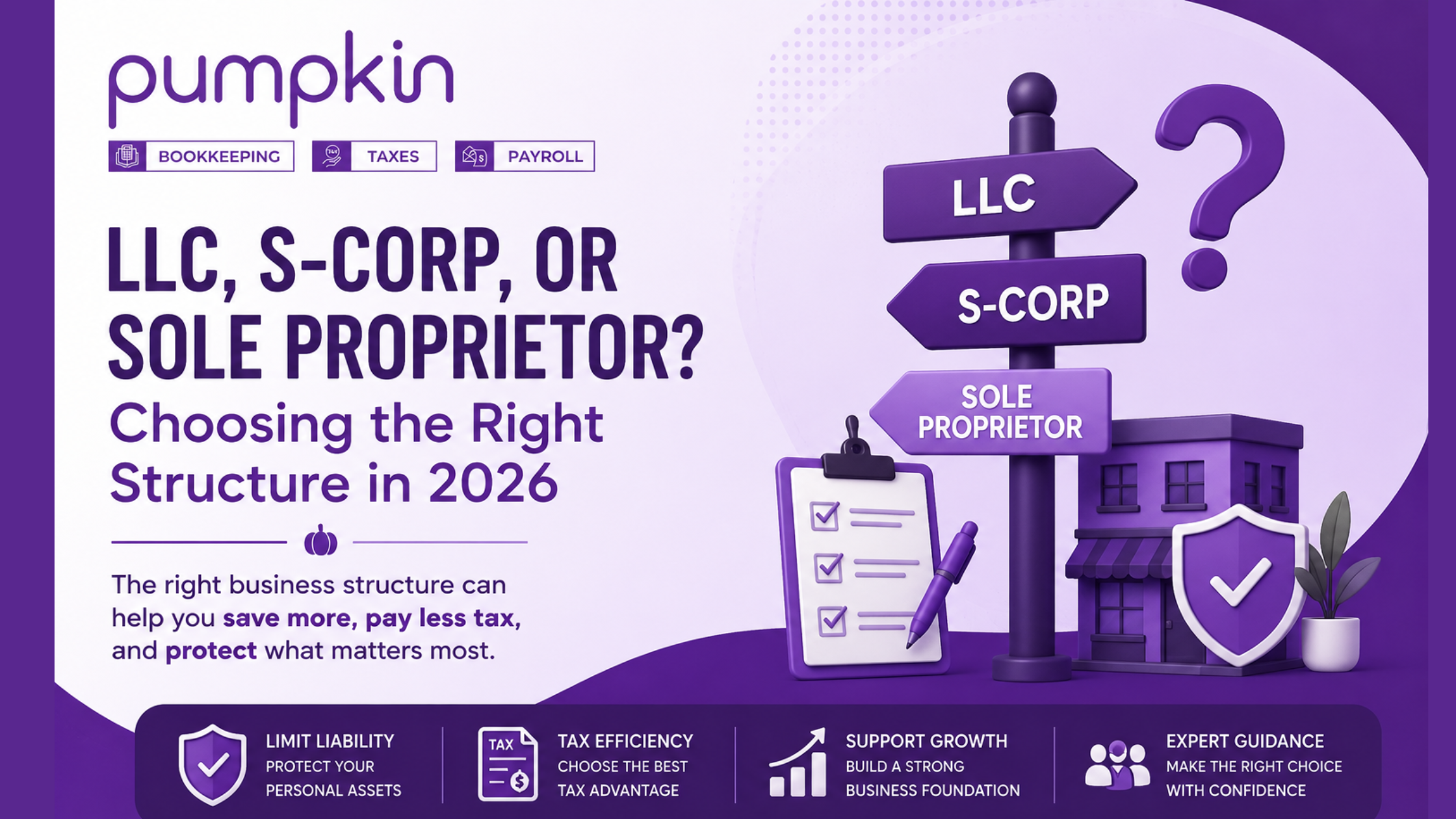
The Business Structure You Choose Could Save—or Cost—You Thousands in Taxes
Starting a business is exciting, but choosing the wrong business structure can lead to higher taxes, unnecessary paperwork, and missed opportunities for growth.
One of the most common questions entrepreneurs ask is:
“Should I operate as a Sole Proprietor, LLC, or S-Corporation?”
The answer depends on your income, liability concerns, growth plans, and tax strategy.
As tax laws evolve and more small businesses embrace digital operations, selecting the right entity structure in 2026 is more important than ever.
This guide explains the key differences between Sole Proprietorships, LLCs, and S-Corps, helping you determine which option may be best for your business.
What Is a Sole Proprietorship?
A Sole Proprietorship is the simplest business structure. If you start a business without registering a separate legal entity, you are automatically considered a sole proprietor.
Benefits of a Sole Proprietorship
- Easy and inexpensive to start
- Minimal paperwork
- Simple tax filing
- Complete control of business decisions
Drawbacks of a Sole Proprietorship
- No personal liability protection
- Personal assets may be at risk if the business is sued
- Subject to self-employment taxes on all profits
- May appear less credible to investors and lenders
Best For
- Freelancers
- Consultants
- Side hustles
- New business owners generating limited revenue
What Is an LLC?
A Limited Liability Company (LLC) creates a legal separation between you and your business.
This structure protects personal assets while maintaining flexibility in taxation.
Benefits of an LLC
- Personal liability protection
- Flexible management structure
- Fewer compliance requirements than corporations
- Can choose different tax classifications
Drawbacks of an LLC
- State filing fees and annual reports
- Self-employment taxes may still apply
- More administration than a sole proprietorship
Best For
- Growing small businesses
- Service-based companies
- E-commerce businesses
- Businesses with potential liability risks
What Is an S-Corporation?
An S-Corporation is not a business entity itself. Instead, it is a tax election available to qualifying LLCs and corporations.
Many business owners elect S-Corp status to reduce self-employment taxes.
Benefits of an S-Corp
- Potential payroll tax savings
- Pass-through taxation
- Enhanced credibility
- Can reduce overall tax liability
Drawbacks of an S-Corp
- Payroll requirements
- Additional tax filings
- More compliance obligations
- Reasonable salary rules must be followed
Best For
- Established businesses
- Owners earning consistent profits
- Businesses generating $60,000+ in annual net income
- Companies seeking tax optimization
LLC vs. S-Corp: What’s the Difference?
Many business owners mistakenly compare LLCs and S-Corps as if they are competing structures.
In reality:
An LLC is a legal entity.
An S-Corp is a tax election.
You can have:
- Single-Member LLC
- Multi-Member LLC
- LLC Taxed as an S-Corp
This flexibility is why many growing businesses choose an LLC first and then elect S-Corp taxation when profits increase.
Tax Comparison for 2026
Sole Proprietor
- Reports business income on Schedule C
- Pays income tax
- Pays self-employment tax on all profits
LLC (Default Taxation)
- Similar taxation to sole proprietorship for single-member LLCs
- Pass-through taxation
- Self-employment taxes generally apply
S-Corp Election
- Owner receives a reasonable salary
- Remaining profits may be distributed as dividends
- Potential reduction in self-employment taxes
For profitable businesses, this difference can potentially save thousands annually.
Questions to Ask Before Choosing a Structure
Do You Need Liability Protection?
If protecting personal assets is important, an LLC may provide significant benefits over a sole proprietorship.
How Much Profit Does Your Business Generate?
Businesses generating substantial profits may benefit from S-Corp tax treatment.
Are You Planning to Grow?
If you plan to hire employees, secure financing, or expand operations, a more formal business structure can support future growth.
How Much Administrative Work Can You Handle?
S-Corps require additional compliance, payroll processing, and reporting.
Common Mistakes Business Owners Make
Waiting Too Long to Change Structures
Many owners continue operating as sole proprietors long after their business has outgrown the structure.
Choosing an S-Corp Too Early
Not every business benefits from S-Corp taxation. The administrative costs may outweigh potential tax savings.
Ignoring State Requirements
Entity registration, annual reports, and compliance requirements vary by state.
Failing to Seek Professional Advice
The right structure depends on your specific business goals, revenue, and long-term plans.
Which Business Structure Is Right for You?
| Situation | Recommended Structure |
| New freelancer or side hustle | Sole Proprietorship |
| Growing business seeking liability protection | LLC |
| Established business with strong profits | LLC with S-Corp Election |
| Business planning for expansion | LLC or S-Corp |
There is no one-size-fits-all answer.
The best choice depends on your income level, risk exposure, growth plans, and tax objectives.
How Pumpkin Tax Co Can Help
Choosing the right business structure is one of the most important financial decisions you’ll make.
At Pumpkin Tax Co, we help business owners:
- Evaluate entity options
- Analyze tax implications
- Establish LLCs
- Determine S-Corp eligibility
- Manage bookkeeping and payroll
- Develop long-term tax planning strategies
Our goal is to help you build a compliant, tax-efficient business structure that supports future growth.
Final Thoughts
Whether you’re launching a new venture or considering a change in business structure, understanding the differences between Sole Proprietorships, LLCs, and S-Corps can help you make smarter financial decisions.
The right structure can provide liability protection, improve tax efficiency, and create a stronger foundation for long-term success.
Before making a decision, consult with a qualified tax professional who can evaluate your unique circumstances and recommend the most advantageous path forward.
For more details Contact Us
FAQs
- Should I choose an LLC, S-Corp, or Sole Proprietorship in 2026?
Choose an LLC for liability protection, an S-Corp for potential tax savings, or a Sole Proprietorship for the simplest business setup.
- What is the difference between an LLC and an S-Corp?
An LLC is a legal business structure, while an S-Corp is a tax classification that can provide tax advantages.
- Is an LLC better than a Sole Proprietorship for small businesses?
Yes, an LLC offers personal liability protection, greater credibility, and flexible tax options compared to a Sole Proprietorship.
- When should an LLC elect S-Corp tax status?
An LLC should consider S-Corp tax status when its profits consistently exceed the level where payroll tax savings outweigh added compliance costs.
- How much can an S-Corp save in taxes compared to an LLC?
An S-Corp can potentially save business owners thousands of dollars annually by reducing self-employment taxes.
- What are the tax benefits of an S-Corp in 2026?
An S-Corp can reduce self-employment taxes while allowing profits to pass through directly to the owner’s personal tax return.